TL;DR: Just because the plant hasn't blown up today doesn't mean your systems are working. We often mistake a lack of disaster for the presence of safety. This is "Counterfeit Confidence", a forged currency we use to buy peace of mind while the Overton Window of our standards shifts toward catastrophe. To fix it, we have to stop acting like "Auditors" who check boxes and start acting like "Architects" who build systems that resist the drift.
The air in a fabrication shop at 2:00 AM has a specific weight. It’s a mix of scorched ozone, stale coffee, and the rhythmic, industrial heartbeat of a CNC machine chewing through 4140 steel. You’re standing there, watching a veteran operator bypass a light curtain because the sensor is finicky and "it’s slowing down the cycle time." He does it. The part clears. No one loses a finger. He looks at you, shrugs, and says, "See? So far, so good."
That phrase should make your skin crawl.
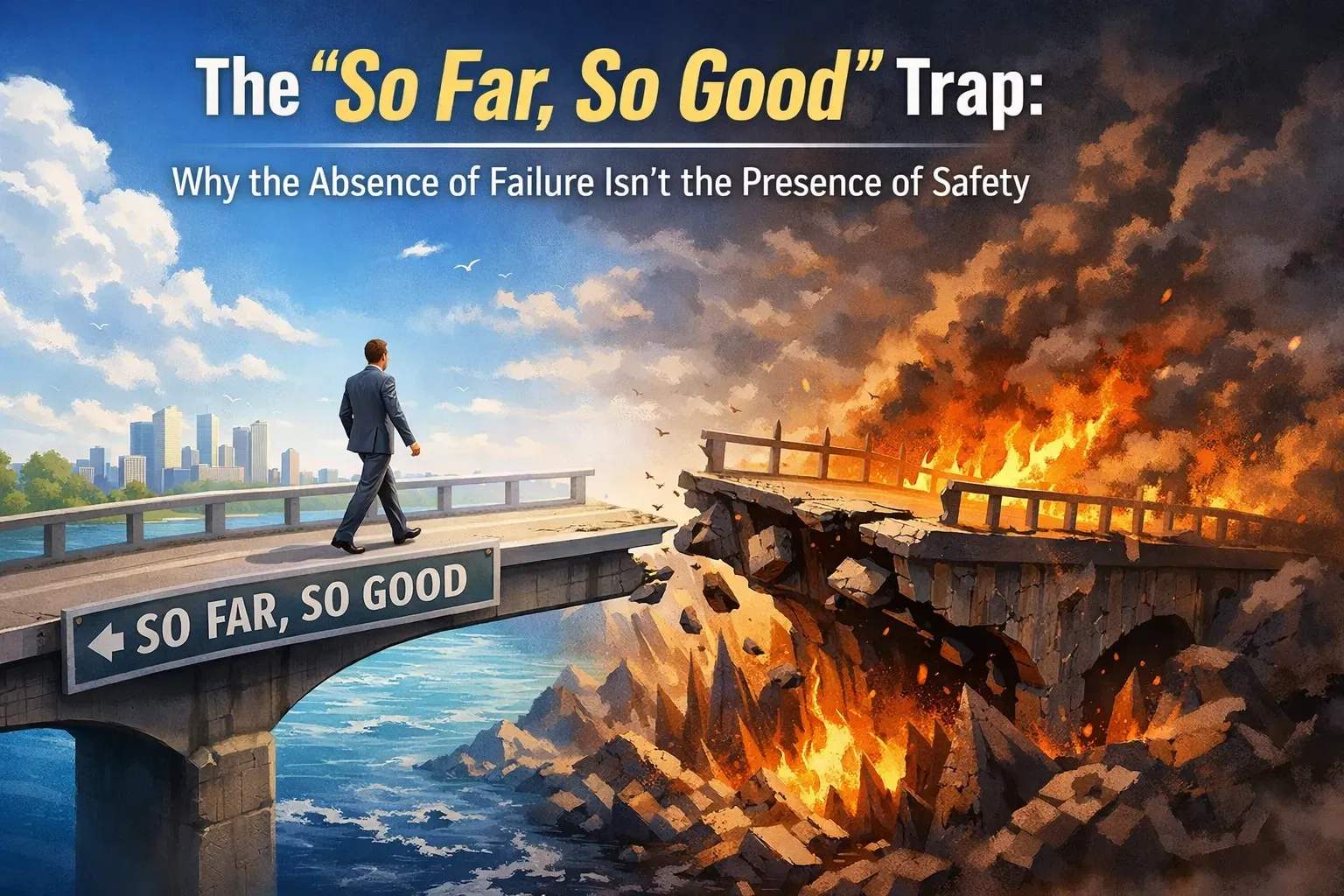
In the world of organizational development and high-stakes operations, "so far, so good" is the sound of a ticking time bomb. It’s the mantra of a dangerous game of roulette where you’ve convinced yourself that because the hammer fell on an empty chamber five times, the gun isn't loaded.
We aren't building safety or excellence; we are just accumulating luck. And luck is a terrible strategy.
The Shifting Overton Window of the Shop Floor
Counterfeit Confidence: Trading Truth for Sleep
There is a massive difference between
False Confidence and
Counterfeit Confidence.
False Confidence is an honest mistake. You genuinely believe the bridge is rated for ten tons, but it’s actually rated for five. You’re wrong, but you’re not lying to yourself. You lack the data.
Counterfeit Confidence, however, is a forged currency. You know the bridge is shaky. You’ve seen the cracks. But because you’ve driven over it ten times and it hasn't collapsed, you print a mental "Safe to Cross" bill and spend it to buy yourself some peace of mind.
It’s an active choice to ignore the "Work as Done" because the "Work as Written" is too hard to enforce.
In our
team performance consulting, we see this everywhere. Leaders accept counterfeit confidence because the alternative is a mess. If you acknowledge that the standard has drifted, you have to stop production. You have to retrain. You have to have "The Talk" with the Enforcer who is hitting his numbers but breaking the culture.
So, you take the counterfeit bill. You say, "So far, so good." You tell yourself that since it hasn't happened yet, it means it won't happen.
But the absence of failure is not the presence of safety.
Safety (and quality, and culture) is an active presence. It’s the
LIT (Leadership, Intent, and Trust) that holds the line when the pressure is on. Counterfeit confidence is just a temporary loan from the universe, and the interest rates are catastrophic.
The Roulette Wheel of Operational Drift
From Auditor to Architect: Using the Ownership Index
In the
Ownership Index Framework, we look at how leadership archetypes handle this drift.
Most companies are stuck in the
Managed Phase. They have
Auditors. An Auditor’s job is to check the box. They look at the paperwork, see that the "Safety Checklist" was signed, and they move on. The Auditor loves Counterfeit Confidence because it makes their reports look clean. As long as the "Tells" (the visible signs of compliance) are there, they don't dig into the "Resolve" (the actual commitment to the standard).
To break the "So Far, So Good" trap, you have to move into the
Embedded Phase. You need
Architects.
An Architect doesn't just ask, "Did we hit the number?" They ask, "How did we hit the number, and did we burn the house down to do it?"
An Architect looks for the drift. They know that the Overton Window is always trying to slide toward the easiest, fastest, and most dangerous path. They build systems that make the right way the easy way, and they maintain a "chronic unease" about the absence of failure.
The Roulette Wheel of Operational Drift
The Cost of Peace of Mind
We all want to go home at night feeling like we’ve done a good job. We want to believe our teams are safe and our processes are robust. Counterfeit confidence is a very tempting way to get that feeling. It’s cheap, it’s easy, and it works: right up until the moment it doesn't.
But real leadership isn't about feeling comfortable. It’s about the "Unmanagement" of the status quo. It’s about being the person who points at the "So far, so good" and calls it what it is: a lie we tell ourselves to avoid the hard work of building real ownership.
If you’re tired of playing roulette with your operational standards and you’re ready to stop trading your future for a few days of quiet, maybe it’s time to look at the artificial intelligence of your systems or the strategy of your leadership.
The "So Far, So Good" trap is only a trap if you stay in it.
Stop checking boxes. Start building foundations. Because eventually, the roulette wheel stops spinning, and "So far" becomes "Too late."
How much counterfeit currency is sitting in your desk drawer right now?