AI is for Tasks, Humans are for Coaching: Why You Can’t Prompt Your Way Through a Crisis

TL;DR: AI is a godsend for scheduling maintenance and crunching production data, but it’s a liability when it comes to human behavior. Coaching requires context, nuance, and field-tested wisdom: things a Large Language Model simply cannot simulate. When things go "nuclear" on the shop floor, a chatbot's advice isn't just useless; it’s dangerous. Real transformation happens human-to-human.
Read Time: 7 minutes
Audience: Plant Managers, Ops Directors, and Leaders who have tried "program-of-the-month" fixes and are still dealing with the same fires.
I am seeing more and more push for training AI as a coach: to provide feedback, to give advice, to help with difficult conversations. The problem is that ai isn’t human.
The siren song of AI is everywhere. "Let the machine handle your leadership development," the tech bros say. "It’s faster, cheaper, and it has the entire internet’s knowledge at its fingertips."
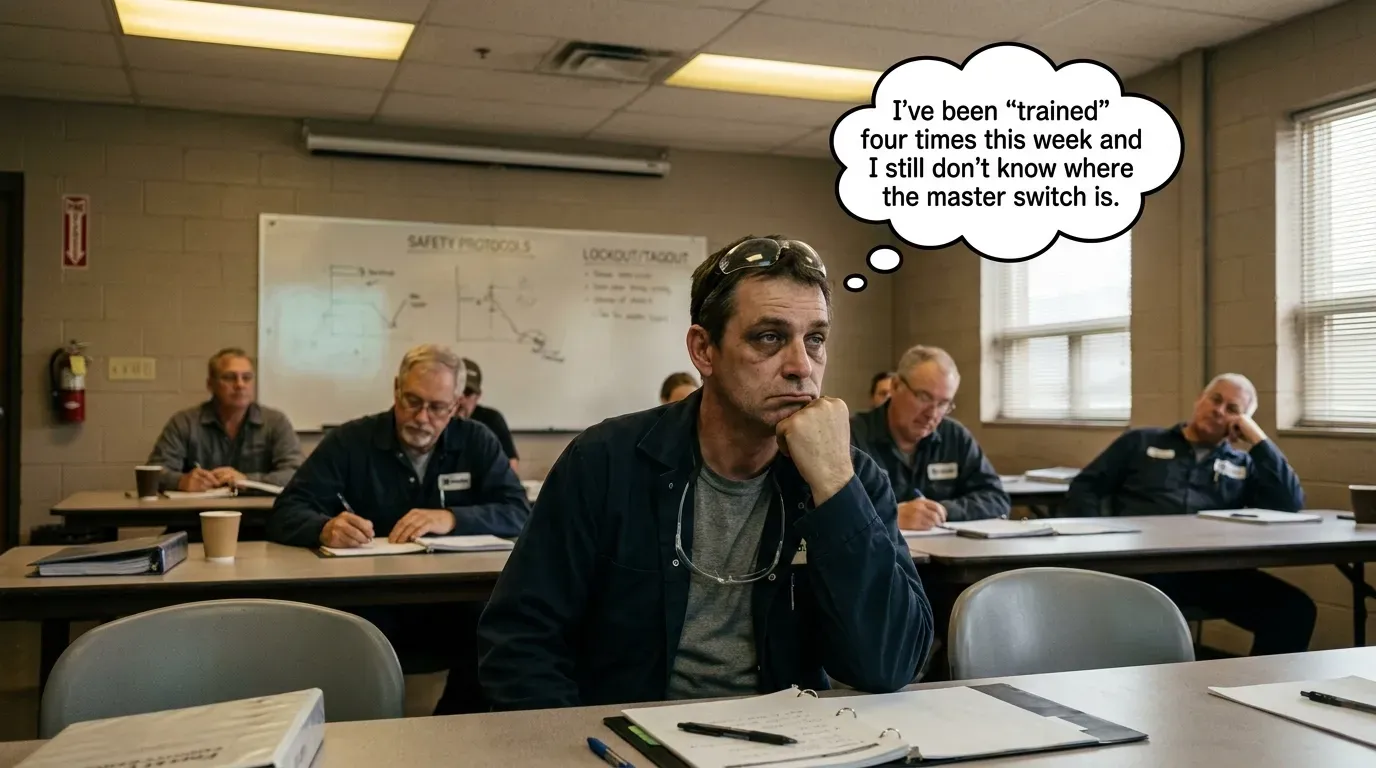
It sounds great until you’re standing in a 110-degree refinery, and your Ops Director is screaming at a supervisor because a pump failed and the 11 PM shift report was a fiction. In that moment, the "entire internet’s knowledge" is just a collection of unvetted noise.
Ai is for tasks. Humans are for coaching.
At Isomerics, we help leaders turn strategy into behavior. We’ve spent 20 years inside operations, not just consulting to them. We know that in the high-stakes world of industrial manufacturing and healthcare, "good enough" advice is a recipe for a safety incident or a mass exodus of your best talent.
To prove it, let’s look at what happens when you ask a machine to handle a human crisis.

For example, I was doing some experimenting with AI recently. I gave it a scenario I delt with recently and one I see in industrial operations all the time — a plant manager dealing with an operations manager who blows up under pressure. Yelling, slamming doors, cuss-filled butt-chewing phone calls at 11pm. People stop bringing him problems because they don't want to catch him on a bad day.
So for fun I asked the AI what it thought I should do?
Its first piece of advice was something it called a pattern interrupt. Drop a pen on the table mid-outburst. The physical disruption, it explained, would break the loop of escalation. The volatile person would experience a half-second of silence, and you could use that silence to redirect the conversation.
I liked the idea of pattern-interrupt and it sounded like good advice until I gave it some Critical thought.
Then I wondered how this would actually work so I pushed back and asked. “Won't he notice I'm doing something to him?” The AI agreed this was a risk and suggested a subtler version — “The water Move” I was too pick up a glass of water and take a slow drink. This would create a natural, incidental pause and according to the ai, would be harder to clock as a technique.
This definitely seemed like bad advice so I pushed back again. He's in a high-arousal state. Subtle moves won't reach someone who's already escalated. The AI agreed again. It pivoted to the harder version of the technique. Drop a heavy binder on the floor. The louder the disruption, the more reliably it would break the loop.
Think about that for a second. You have a volatile, screaming leader in a high-pressure industrial environment, and your plan is to slam a binder onto a steel floor to "reset" him? In any plant I’ve ever worked in, that doesn’t lead to a "breakthrough." It leads to an escalation that ends in HR or a hospital.

The Hallucination of Helpful Advice
After I rolled my eyes and shook my head I asked the AI directly whether the pattern interrupt technique was tried-and-true. Did it have research behind it? Was there evidence it worked in workplace de-escalation?
The AI admitted it didn't. The technique comes mostly from NLP — neuro-linguistic programming, a coaching framework whose core claims have mostly been debunked or never properly tested. The legitimate de-escalation research, used by hostage negotiators, crisis intervention training, and workplace violence prevention guidelines, points the opposite direction. The actually-evidenced approach is to lower your voice below theirs, slow down, refuse to participate in the escalation loop, and let the outburst burn itself out. Sudden loud disruptions don't break the loop. They feed it.
The AI had been giving me confidently wrong advice for three rounds before I cornered it. This is the fundamental flaw of AI adoption in leadership: AI prioritizes being "helpful" and "confident" over being right.
That's the part worth thinking about.
The AI wasn't malicious. It wasn't trying to get someone hurt. It was doing what AI models do — generating the most statistically likely answer to my question, drawn from a training set that included a lot of coaching content, sales tactics, and pop-psychology writing where pattern interrupts are talked about with great confidence. It pulled that confidence into its answer and presented it as if it were established practice. Which, to anyone reading without a background in real de-escalation work, it would have sounded like.
This is the failure mode I want operations leaders to understand. AI doesn't lie. It also doesn't know when it's wrong. It produces answers that match the shape of what's been written about a topic, and the shape of what's been written about workplace de-escalation includes a lot of unvetted coaching jargon presented as if it were evidence-based. The AI doesn't have a way to tell the difference between what's evidenced and what's just frequently repeated.
The only thing that caught the problem in my conversation was that I knew enough about the actual research to push back. If I hadn't, I'd have walked away with a list of three techniques to try, the most aggressive of which would have made the situation worse. The AI would have delivered all three with the same confidence.
That's not a problem unique to AI. People do the same thing — they read one book on a topic and start handing out advice as if they're experts. But the AI does it at scale, with infinite patience, and with a confidence calibration that doesn't match the actual reliability of what it's saying. It sounds the same whether it's right or wrong. There's no tell.

The bigger problem isn't bad advice. It's the wrong job.
Even if the AI had given me good advice, it would still be the wrong tool for what the plant manager actually needed.
The plant manager's real problem wasn't how do I handle the next blowup. That's the surface question. The real problem was how do I help my ops director see what his behavior is costing him — which is a coaching problem, not an information problem.
Coaching isn't about giving someone answers. It's about asking the questions that help them find their own. People don't change because someone hands them a list of things to do differently. They change because they finally see something about themselves they couldn't see before — and the way they see it is by being asked the right question at the right moment.
That's what the plant manager actually needs help with. Not a script. The skill to ask the question that lands. What were you trying to accomplish in that conversation? What do you think your team heard? When did you first notice things going sideways? Those questions, asked with patience, in the right moment, with enough silence after each one to let the ops director actually think — that's coaching.
AI can't help with any of that. It can't read the ops director's face when the question lands. It can't tell when to push and when to wait. It can't hold the silence that lets the realization happen. Ask it for advice and it gives you answers. Ask it again and it gives you more answers. It's an answer machine in a job that needs a question asker. Coaching is the opposite of what AI is built to do — and no amount of “AI training” will change that, because the limitation isn't in the answers. It's in the architecture.

What real coaching skill looks like
If AI isn't the answer, the question becomes — what is?
Real training in how to ask, not how to answer. That's a different muscle than most leaders were ever built for. Most got promoted because they were good at solving problems, which means their default under pressure is to grab the wheel — diagnose what's wrong, hand the person a fix, and move on. That works for technical problems. It fails for behavior.
The ops director already knows the behavior is a problem. That's why he apologizes the next day. What he doesn't have is the insight into why it keeps happening, what the pattern is costing him operationally, and what would have to change for him to act differently next time. None of that gets unlocked by being told. It gets unlocked by being asked.
Leaders who learn to coach well develop four muscles:
- Ask a question and wait for the answer. Don't jump in with your own when the silence gets uncomfortable. The silence is where the thinking happens.
- Read what isn't being said. The ops director who says I'll work on it with a clipped tone and no eye contact isn't actually committing to anything. AI can't see that. A human can.
- Adjust in real time. Notice when the person is opening up versus closing down, when they're ready to be pushed versus when they need space.
- Resist the urge to fix. Stay in the question. Trust the process. The ops director gets stronger because he had to find it himself.
That's not something AI can train, because the practice that builds the muscle is the practice of doing it with a real person who responds in real time with real emotions — sometimes the volatile kind. If you want your leaders to actually coach the people who report to them, you have to train them to ask, not to answer. That takes time. And it can't be downloaded.

What this means for how you use AI in your operation
I'm not anti-AI. I use it constantly. It's useful for tasks where the right answer is verifiable — drafting documents, summarizing meetings, working through code, organizing data. In those domains, if the AI is wrong, you can usually tell pretty quickly.
The trouble starts when you use AI for tasks where the right answer is judgment-based and the verification loop is long. Leadership advice. Conflict handling. Personnel decisions. Coaching. Those are domains where bad advice doesn't reveal itself for weeks or months. By the time you find out the binder slam was a mistake, you've already had the meeting where you tried it.
If you're going to use AI in those domains anyway — and you probably should, because there's real value there — protect yourself with two habits.
- Push back on confident-sounding advice. If the AI gives you a technique with a name (pattern interrupt, active listening, radical candor), ask it directly whether the technique is supported by research. A well-trained model will usually admit when the evidence is thin if you ask the question plainly. The catch is you have to know to ask.
- Notice when the advice escalates. In my conversation, each time I pushed back, the AI's advice got more aggressive rather than more careful. That's a tell. Confident systems should respond to challenge by getting more cautious, not more dramatic. When the AI's third answer is a louder version of the first one, you're not getting expertise. You're getting confidence about something it hasn't actually thought through.
The thing I keep coming back to
The most useful insight from the whole exchange wasn't anything the AI told me. It was watching what happened when I asked the obvious question — is this technique actually evidence-based? The AI immediately backed down. The confidence dissolved. It explained that it had been citing coaching tradition rather than research, and walked me to the actually-evidenced approach in two paragraphs.
It knew the better answer the whole time. It just didn't volunteer it.
That's the dynamic to remember. AI will give you the most likely-sounding answer, not the most carefully-vetted one. The vetting is your job. If you don't do it, you'll end up acting on advice that sounds like expertise but isn't.
For tasks where the answer is checkable, that's fine — you'll catch the errors quickly. For judgment work, where the errors are slow to surface and expensive to undo, you need to bring your own skepticism to the conversation.
The AI won't tell you when it's wrong. You have to ask.
Contact Us