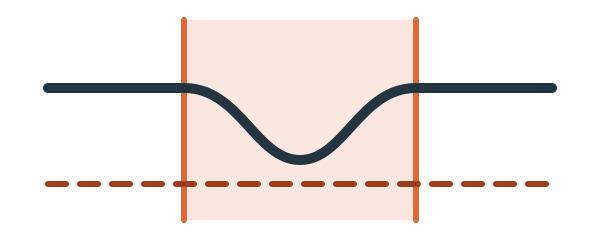
THE HOLD WINDOW CARD

The Hold Window Card

Set the line, the time and the decider before go-live, while everyone is still calm.

Use it when A change is about to go live and results will get worse before they get better.
It answers Is your line real, is there enough room and time, and will anyone hold to it?
It won't Predict how deep or how long your drop will be, or tell you whether the change is right. It works on one change, one group, one number, over weeks or months. It won't carry a merger or a whole transformation.
The Hold Window Card: a dip inside a window, held above a line

Why results drop

Every change costs something before it pays, and the cost lands in three places.

You lose output. People are slower on a new way than on one they have done for years. New software means looking for the field that used to sit in front of them. A new process means stopping to check the step. A new structure means working with people they have not worked with before.

You get rework. People get it wrong early and somebody fixes it afterwards. Records go in twice. Requests come back. Work gets done, then gets done again.

You lose some morale. People who are good at their job feel slow, and that wears on them. Managers spend their day answering complaints. Everyone is working harder for a worse number, and that is where people start asking whether this was worth it.

How long it lasts depends on what you changed. A new form might cost a week. A new system, a new structure or a new owner can run for months.

The drop itself surprises nobody. What nobody has agreed is how far down is still normal, and how long that can last. Then the number comes in low, and whoever speaks loudest decides. This card settles it while everyone is calm.


Step 1

The change and the number

Paste the handoff block and the change name fills in. Skip this if you didn't use it.

For example An electronic shift log replacing the paper logbook. A new approval route for purchase requests.

Does anyone senior still think this is the wrong change?

Which number

Pick the one that will be used against the change, not the one that proves the benefit. The test: when somebody says this isn't working in week three, which number do they point at?

Three checks on your choice. It already gets reported without anyone doing extra work. Somebody outside the project watches it. And the people doing the new way affect it directly.

For example Units packed per shift. Work orders closed per week. Calls handled per day. Days to approve a request.

Does that number already get reported without anyone doing extra work?

Which way is better for this number?

Step 2

What the number does on its own

Ten minutes with a report you already have

Take the last eight to twelve readings from a stretch when nothing was changing. Write down the highest and the lowest. That is the range ordinary weeks move in, and it tells you what the number can prove.

A drop inside that range can't settle any argument. Neither can a line inside it, because a normal bad week crosses it.

Step 3

The line

Why set a line at all

A line says what evidence would change your mind, written down before anyone has something to defend. Skipping it doesn't avoid the question. It just moves the answer to the worst week, with the angriest people in the room.

Set it from where things break, not from the drop you expect. You can look up where it hurts. The drop is a guess.

For example Overtime starts. A customer commitment gets missed. Somebody outside has to be told. The backlog stops clearing by Friday.

Step 4

The drop you expect

Where does that number come from?

Has any of this been run small first?

Step 5

How long it can last

Count repetitions, not weeks

People get good at something by doing it, so recovery runs on repetitions. Somebody doing the task every day has dozens of goes by week four. Somebody doing it monthly has three goes by month three, and three goes is still learning, whatever the calendar says.

How often does one person do this task?

A monthly review, a quarter close, a budget meeting, a planning session.

Will the people at that review know the drop was expected?

Step 6

The first sign it's working

Something you see before the number moves

The number comes back last. Something else moves first, and it is usually the behaviour itself.

For example Handovers using the new form. Requests arriving complete. Jobs started without a call to the office. People no longer asking where the old file went.

Can somebody count that every week?

Step 7

Who calls it

By role, not by name.

For example Operations manager. Plant manager. Head of shared services.

Is that the person whose idea this was?

What's been committed so far?

Have they agreed to this window?

For example The manager whose numbers it hits. Head office. A customer. Nobody we can name yet.

Does the decider outrank that pressure?

Step 8

The exit

If we hit the line, what happens?

Can you go back?

For example The paper form, which is still in the cupboard. A half version, with the new route and the old approvals. Nothing that works, because the old system is switched off.

The thing that would stop it on the spot even if the number looked fine.

For example Customers start telling us. A second thing breaks that nobody predicted. The new way turns out to cause a risk we didn't see.

Step 9

Who knows the drop is coming

Who has been told results will fall for a while?

Tick the ones who have actually heard it, not the ones on a distribution list.

Step 10

What they're already carrying

Did the Load Check say this group is full or worn out?