
CONSULTING — SAFETY CULTURE & PERFORMANCE
The Answer Isn't Another Policy
When something goes wrong, the instinct is almost always the same — write a new rule, add a step to the procedure, require another signature. The policy binder gets thicker. The behavior doesn't change. Your people don't need more rules. They need the ones you already have to mean something.
Isomerics works with operations leaders to close the gap between the safety program that exists on paper and the one that actually runs your facility.
WE BELIEVE
Safety is a
value. Not a priority.
Priorities compete. Values guide.
When safety is a priority, it sits on a list next to production, cost, and schedule. And when those priorities conflict — and they will — safety becomes negotiable.
When safety is a value, it doesn't show up on the list at all. It shapes how every other decision on the list gets made.
The operations we respect most understand the difference. Their frontline people don't stop work because a rule said to. They stop because the culture made it unthinkable not to.
That's what we build.
Human error isn't a cause. It's a conclusion.
When something goes wrong, the easiest explanation is that someone made a mistake. Failed to follow the procedure. Missed the hazard. Took a shortcut.
That explanation feels satisfying because it ends the investigation. One person, one error, one corrective action. Back to work.
It also explains nothing.
Experienced operators don't bypass procedures because they forgot them. Supervisors don't look away from near-misses because they don't care. Good crews don't cut corners because they're reckless. They do these things because, inside the system they work in, that behavior is the rational choice.
Before you can change the behavior, you have to understand the context that produced it. That said, before you can fix the system, you have to be willing to name the choices people made inside it. That's where real safety culture work begins — and it's where most safety programs stop.

How We Work
Isomerics' approach to safety culture draws from two bodies of practice that, together, give operations leaders a complete picture: Human and Organizational Performance (HOP) & Loss Prevention System (LPS)
Human and Organizational Performance (HOP)
A practitioner-first way of thinking about safety that treats error as normal, treats context as the real driver of behavior, and focuses leaders on learning instead of blame. Originally refined in commercial nuclear, now widely adopted across refining, chemical, aviation, and healthcare. The core principles are simple, but the discipline to apply them is not:
- Error is normal. Even the best people make mistakes.
- Blame fixes nothing. It ends the conversation before learning starts.
- Context drives behavior. If good people are making bad decisions, look at the system.
- Learning and improving is vital. Safety-II — studying why work goes right — matters as much as studying why it goes wrong.
- How leaders respond to failure determines whether the organization learns or hides.
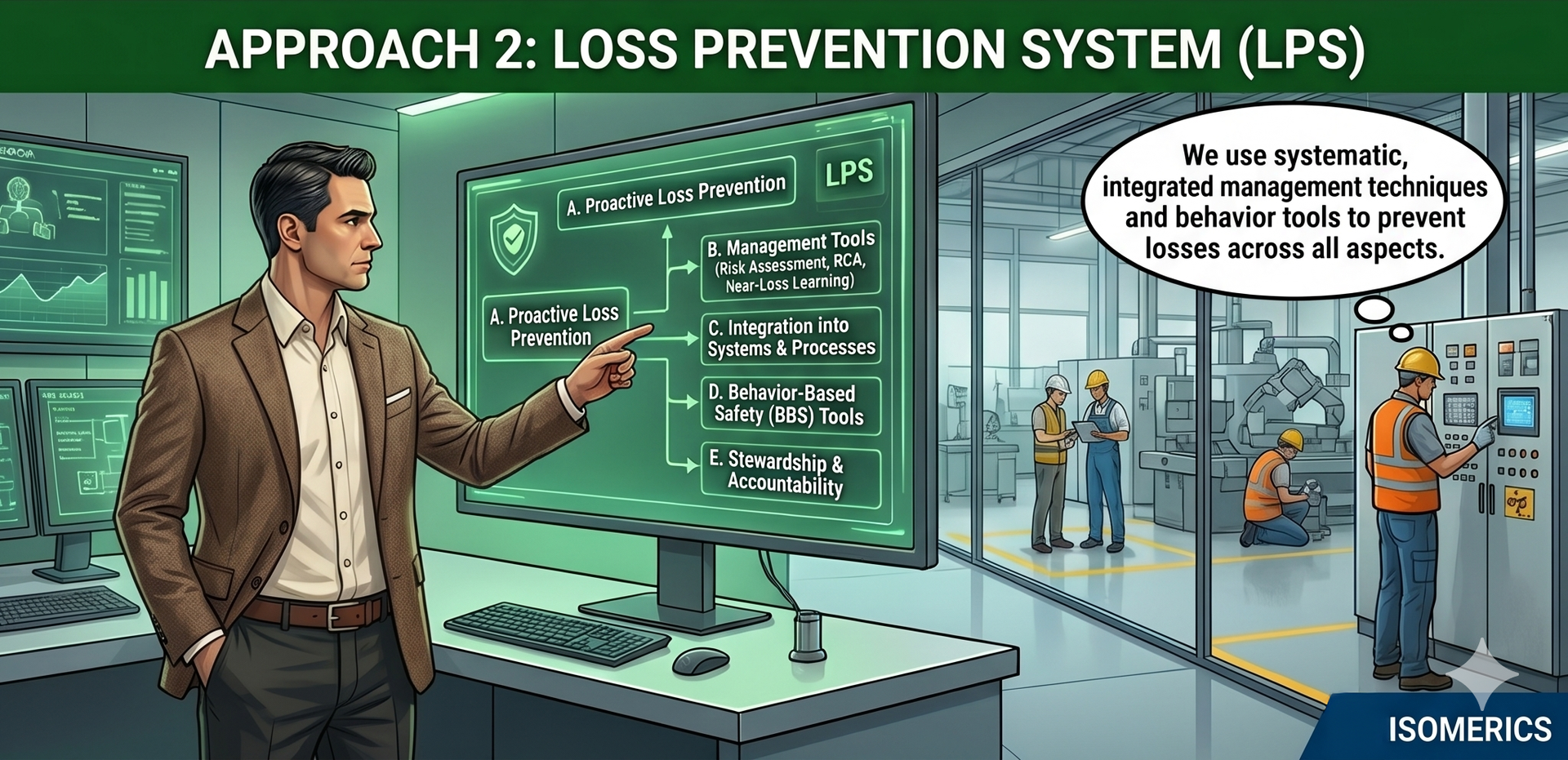
Loss Prevention System (LPS)
A proven observation, feedback, and learning system built in and for heavy industrial operations. Developed inside the petroleum and petrochemical industry and now used across refining, chemical, mining, manufacturing, and construction worldwide. LPS gives operations leaders the tactical infrastructure that turns safety culture from a poster into daily practice:
- Pre-job briefings that surface risk before the work starts, not after.
- Peer observations that build shared ownership of safe behavior across the crew.
- Self-assessments that put the worker in the analytical seat, not just the observed one.
- After-action reviews that close the loop and feed learning back into the system.
- Leadership engagement activities that make safety visible at every level, every day.
The Integration
Most safety programs give you one without the other. HOP without tools stays philosophical. LPS without HOP becomes surveillance — a checklist exercise your crew quietly learns to perform well during audits and ignore the rest of the time.
We install them together. The tools reinforce the culture. The culture gives the tools their meaning. Your observers stop looking for violations and start learning from the work. Your after-action reviews stop closing the file and start changing the system.
Underperformance lives in one of four places. Sometimes more than one simultaneously.
PROCESS
The way work flows — or doesn't. Handoffs that drop critical information. Onboarding that produces bodies not contributors. Training that happens but doesn't change behavior. When the process is broken the people inside it look like the problem. Before you assume it's a people problem, it's worth asking what the process is actually set up to produce.
SYSTEMS
Performance management. Recognition. Feedback loops. Accountability structures. These systems are the hidden architects of behavior. A supervisor who knows their review is based on throughput and incident numbers will protect throughput and incident numbers — even when doing so means looking the other way, skipping the difficult conversation, or reporting what looks good instead of what's true. You can't coach your way out of that. The system is giving clear instructions. Until the system changes, the behavior won't.
CAPABILITY
The gap between what people are being asked to do and what they've actually been prepared to do. Capability gaps are the most visible dimension — and the most commonly misdiagnosed. Putting someone in a supervisor role without developing their leadership capability isn't a performance problem. It's a setup.
CULTURE
What gets reported and what gets buried. What gets rewarded and what gets quietly tolerated. Culture is the invisible operating system nobody sees until it's the reason everything else stopped working. It's also the most expensive dimension to ignore — because by the time it's visible, it's already costing you.
HOW WE WORK
We start where you are.
Every engagement starts with a conversation about what's happening in your operation — what you're seeing, what you've already tried, and what's at stake if it doesn't change.
From there, one of two things happens.
If you already know what you need — a workshop, a training initiative, A DiSC facilitation for their team — we build it around your operation. Your environment. Your people. Your specific situation.
If the root cause isn't clear yet, we start with a diagnostic. That might be the Operational Health Evaluation that tells you exactly where the gaps are. Or it might be a deeper Gap Analysis — on site, in your operation, talking to the people closest to the work.
Either way, what comes next is specific. A named finding. A prioritized plan. A clear answer to what needs to happen and in what order. No generic programs. No borrowed solutions. No fixes aimed at the wrong problem.
Just work that's built for your operation — and designed to hold after we're gone.
Unbreaking Support Systems
Contact Us
We help organizations unbreak the underlying systems that slow people down, create friction, and block transformation. From workflows and communication to performance and change enablement, we design operations that empower instead of restrict. Because better systems build better outcomes.
- Workflow & Process Redesign - Rethink how work flows across teams—eliminate friction, reduce silos, and make systems people actually want to use.
- Knowledge Management & Internal Communication - Capture, share, and scale what your team knows—without burying it in documents or broken platforms.
- Change Enablement Systems - Build systems that support behavioral change, not just rollout plans—so transformation actually sticks.
- Performance Systems & Feedback Loops - Move beyond annual reviews and lagging indicators—build systems that give real-time clarity, motivation, and accountability.
BEFORE YOU LAUNCH
Better systems are only half the equation.
You can redesign the process, rebuild the feedback loop, and fix the recognition program. If your people aren't brought along through the change — the new system will face the same resistance as the old one did.
That's not a systems problem. That's a change management problem.
Every Organizational Effectiveness engagement at Isomerics includes a change management lens — because the best system in the world fails if the people expected to use it weren't part of building it, don't understand why it exists, or weren't given the capability to operate inside it differently.
Prosci ADKAR methodology ensures that when we redesign how your operation works, your people are ready to work inside the new design — not just aware that it changed.
FAQ
Common Questions About Organizational Effectiveness
What is organizational effectiveness consulting?
Most operations have systems, processes, and structures that made sense when they were built but are quietly working against performance today. Organizational effectiveness consulting identifies which of those are driving underperformance — process, systems, capability, or culture — and builds a plan to fix the root cause rather than the symptom that's most visible. At Isomerics we start with a diagnostic before we start with a solution.
How do I know if my organization has a systems problem or a people problem?
The honest answer is that it's usually both — and they're often connected. A system that rewards the wrong behavior will produce people who behave the wrong way. A capability gap will look like a motivation problem until someone looks closely enough to see what's actually missing. Your operation probably isn't short on effort. It may be short on the right structures and development to channel that effort in the right direction. We help you tell the difference before you start solving.
What's the difference between organizational effectiveness and change management?
Organizational effectiveness is about fixing what's broken in how your operation currently works — the systems, processes, and capability gaps that are limiting performance right now. Change management is about moving people successfully from a current state to a future one during a specific initiative. They're related but distinct. Most organizations need both — fix the underlying system and manage the transition to the new one. At Isomerics both are built into every engagement so the fix actually holds.
How long does an organizational effectiveness engagement typically take?
It depends entirely on where your operation is starting and how deep the root cause runs. A focused diagnostic and targeted intervention can produce visible results in sixty to ninety days. A broader systems redesign — rebuilding performance management, restructuring feedback loops, developing internal capability — typically runs six to twelve months. What we can tell you is that the first conversation will give you a realistic picture of scope before any commitment is made.
Can you work with us on one specific system without a full organizational assessment?
Yes. If you already know what needs fixing — a performance management system that isn't working, a feedback loop that's too slow, a training delivery problem — we can meet you there without requiring a full diagnostic first. The assessment is a smart starting point because it ensures we're fixing the right thing. But it's not a requirement. Your operation, your call.
How do you measure whether an organizational effectiveness engagement actually worked?
Most consultants measure two things — leading KPIs and lagging KPIs. What's about to happen and what already happened. Those matter. But they only tell part of the story.
At Isomerics we measure four areas. Leading and lagging KPIs — the operational numbers your leadership team is already watching. Organizational health metrics — turnover, absenteeism, job satisfaction — the systemic signals that show whether your organization is functioning or quietly deteriorating underneath the numbers. And culture metrics — what your people are actually saying. Not what they put on an engagement survey. What's being said on the floor, in the break room, and in the parking lot after the shift ends.
That last category is usually where the most honest data lives. And it's almost always where the real answer is.
What industries do you work in?
Isomerics works in industrial operations — refineries, chemical plants, petrochemical facilities — mid-market manufacturing, and healthcare operations. The systems and culture problems that drive underperformance in those environments are fundamentally the same. The language and context are different. We've spent twenty years inside industrial operations specifically, which means we understand the environment your people work in — not just the theory of how to improve it.
TIRED OF WORKAROUNDS?
Fix the Real Problem
If something keeps coming back in your operation — the same performance gap, the same culture problem, the same initiative that won't stick — it's not bad luck. It's a root cause that hasn't been found yet.
That's the conversation Isomerics starts with. Not a capabilities deck. Not a proposal before a diagnosis. Just a direct discussion about what's actually happening in your operation and what it's going to take to fix it for good.
If you already know what you need — a workshop, a training initiative, a specific system that needs rebuilding — we can start there too.